Professor O’Donnell continues to provide high quality effective personalised clinical care to all his patients following his transition from the NHS to the Independent Private Healthcare Sector where he considers himself very fortunate to be able to provide patient focussed care that he would expect himself.
In Northern Ireland, Professor O’Donnell is able to provide individualised varicose vein treatment plans for each of his patients which may utilise modern endovenous techniques including Radiofrequency Ablation (RFA) or Foam Sclerotherapy as well as previous traditional open varicose vein operative surgery including varicose vein avulsions (phlebectomies) or combinations of these treatment modalities.
Post-operative treatment advice leaflets for procedures performed by Professor O’Donnell are readily downloadable on the
Patient Information
part of this website.
Professor O’Donnell remains very grateful for permission provided by his patients to highlight different therapeutic processes from previous varicose vein treatments that he has performed. Professor O’Donnell has deliberately removed any identifiable parts contained within images used and has only disclosed procedure performed without any further clinical information.
Professor O’Donnell remains freely available to discuss any of these treatments or other issues with you during your clinic consultation.
Foam Sclerotherapy Treatment
Professor O’Donnell’s provision of Foam Sclerotherapy has been previously described on both the Treatments and Patient Information parts of this website.
Professor O’Donnell is fully aware of the necessity to ensure that sclerotherapy treatment is completed as painless as possible. Professor O’Donnell therefore utilises a smaller 30G micro-needle for all sclerotherapy procedures contrary to previous use of larger 23G butterfly needles. Ultrasound guidance for larger varicosities is absolutely essential to permit safe and effective treatment.
Foam sclerotherapy effectively involves the injection of a chemical irritant to the varicose vein which ultimately causes the vein to occlude prior to gradual resorption and resolution. This is why patients describe an initial stinging sensation for the first few minutes which settles quickly usually after completion of the sclerotherapy procedure itself and application of compression hosiery. The veins initially completely disappear followed by an increase in redness signifying the inflammatory response to the sclerotherapy treatment. Sometimes dressings are applied to any bleeding areas which can be removed when the patients are permitted their first shower 48-hours after the procedure.
Once the initial inflammatory response settled, patients continue to wear their provided compression hosiery for two weeks (first week 24-hours a day and second week daytime only). Once the stockings are removed, patients will notice both bruising and lumpiness which is a reflection of the sclerotherapy blocking the treated veins.
Patients can start to gradually massage the areas and increase pressure as tolerated to ameliorate the lumps whilst use of Arnica® cream during the massage process helps with the bruising. It is not uncommon for the bruising to last many months after your procedure. However, most patients will see a significant benefit at around three months but improvements do continue up to 12 months after your procedure.
Often, further sclerotherapy sessions are required pending the severity of your veins and lower extremity surface area affected.
Professor O’Donnell will provide you with a
foam sclerotherapy post-operative instruction booklet
after your procedure which can also be downloaded from his website.
Radiofrequency Ablation of Varicose Veins
During your initial consultation with Professor O’Donnell, you will be provided with your treatment plan which may involve radiofrequency ablation (RFA) of the great saphenous vein, short saphenous vein or sometimes a larger alternative truncal varicosity. Professor O’Donnell believes that RFA is an excellent modality with proven long-term results for larger and generally straight (less tortuous) main varicose vein channels.
Professor O’Donnell will often combine this treatment with foam sclerotherapy to optimise treatment completion.
Patients are recommended to wear their provided compression hosiery for two weeks (first week 24-hours a day and second week daytime only). Professor O’Donnell will also apply an additional compression bandage called “Peha-Haft” for the first 48-hours. This can be removed and disposed off by you immediately prior to your first shower before re-application of compression hosiery to the treated lower extremity after your shower.
Regardless of historical vascular literature, Professor O’Donnell believes you should benefit from improved skin quality after radiofrequency ablation particularly if you have had previous venous ulceration. However, it is stressed that following endovenous treatment for venous ulceration, you will need to engage in life-long skin care, regular topical moisturiser (at least once a day) and compression hosiery to reduce the risk of long-term ulcer recurrence.
Professor O’Donnell will provide you with his
radiofrequency ablation post-operative instruction booklet
after your procedure which can also be downloaded from his website.
Open Varicose Vein Surgical Procedures
Professor O’Donnell is fully aware that some patients may present with significantly enlarged varicose veins where the calibre and size of such veins do not get optimal results with sole use of endovenous treatment modalities. Over the years, Professor O’Donnell has identified that certain vein sizes simply do not respond completely to the more minimally invasive treatment modalities where treatment failure can occur particularly with foam sclerotherapy or sometimes the foam works optimally but the patient is left with residual lumps that take a significant time to resolve.
During your initial consultation with Professor O’Donnell, he will inform you of potential treatment modalities and if your varicose veins warrant additional open varicose vein avulsions (phlebectomies). Similar to endovenous treatment modalities, varicose vein avulsions are performed under local anaesthetic. Although this procedure does take slightly longer that the endovenous treatments, it remains well tolerated by patients in a very relaxed and informal operating room environment.
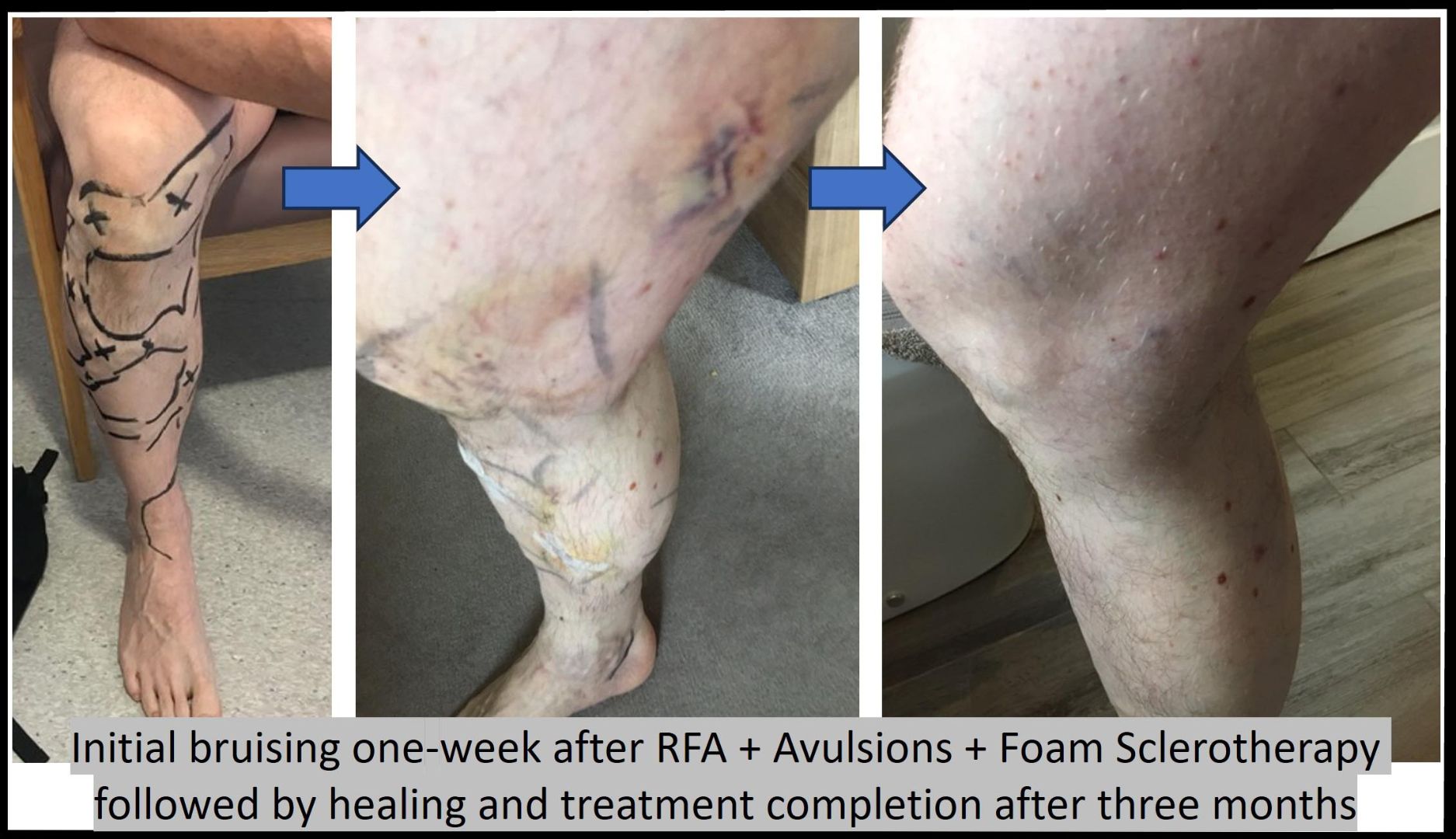
Professor O’Donnell will describe all aspects of your procedure during your informed consent. Please let Professor O'Donnell know if you have any queries or questions about your treatment. Professor O'Donnell will ensure that all aspects of your care are optimised with adequate administration of local anaesthetic to treatment areas.
Once the procedure is completed, patients will have bandaging applied for the first 72-hours combined with compression hosiery (stockings). A first shower is permitted after 72-hours where the compression hosiery is initially removed followed by removal of all the bandages which are then disposed. After your shower, you need to re-apply your compression hosiery which will be a smaller size to account for the absence of all the previous bandages. The compression hosiery is then worn for the next 11-days (day and night for the next four days and daytime only for the following 7 days).
If the skin dressings (steri-strips and mepore) remain adherent to the skin when you have your first shower, this is OK. Please do not worry if they look red and blood stained which is related to local anaesthetic administered during the procedure with some minor ooze through the avulsion / phlebectomies micro-incisions. These dressings can be removed by you if still present after one-week when you shower where they tend to peel off a lot easier.
To re-confirm, patients continue to wear their provided compression hosiery for 24-hours a day for the first week after their procedure and daytime only for the second week. You will be provided with compression hosiery a size smaller than previous for use after your first shower when the bulky dressings have been removed.
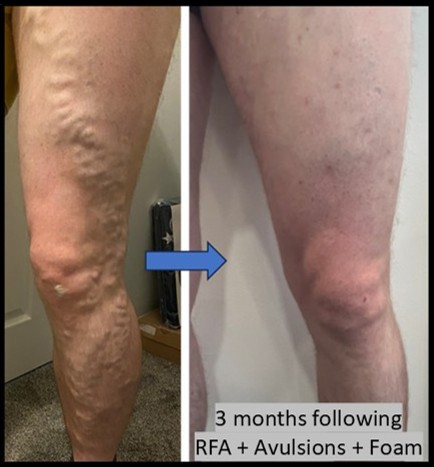
Patients continue to wear their provided compression hosiery for two weeks (first week 24-hours a day and second week daytime only). You will be provided with compression hosiery a size smaller than previous for use after your first shower when the bulky dressings have been removed.
Once the stockings are removed, patients will notice both bruising and lumpiness. Patients can start to gradually massage the areas and increase pressure as tolerated to ameliorate the lumps whilst use of Arnica® cream during the massage process helps with the bruising. It is not uncommon for the bruising to last many months after your procedure. However, most patients will see a significant benefit at around three months but improvements do continue up to 12 months after your procedure.
Professor O’Donnell will provide you with an
open varicose vein post-operative instruction booklet
after your procedure which can also be downloaded from his website.
|
 Phone: 0771 4227 627